Live on Kickstarter — $79 backer price

Grow lion’s mane in complete silence.

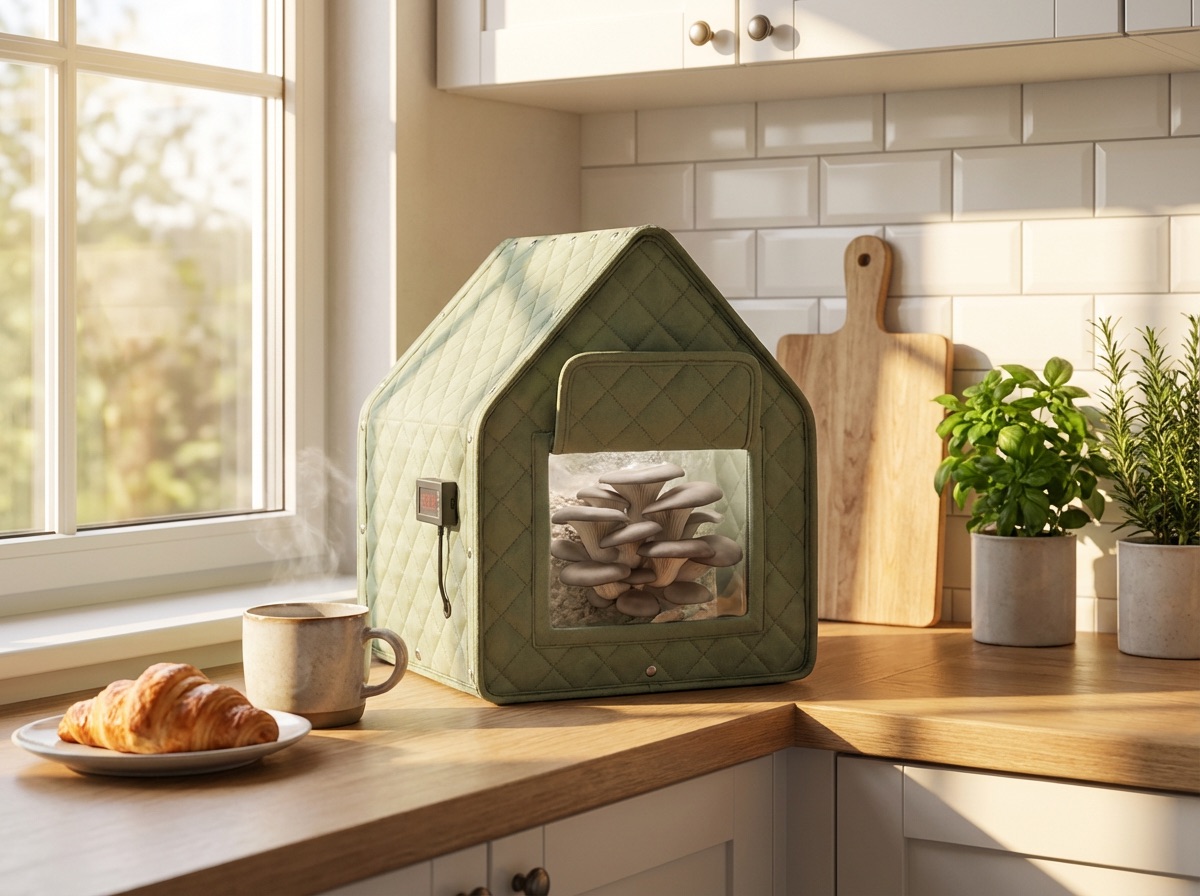
Under 18dB. Two-minute setup. First harvest in 25 days. The Sh-Room Solo fits on a kitchen counter, runs quieter than a library, and ships refill substrate at $3 per grow.

$79·Kickstarter backer price·78% recycled materials
<18dB Silent
2-Min Setup
78% Recycled
Sh-Room Solo on a kitchen counter with mushrooms growing inside
Temperature
75°F Auto
Bag to plate in 25 days

Watch a grow, day by day.

Drag the slider to scrub through a full cycle — from the day you plug in to the day you harvest. No green thumb required.

Day 0
Inoculation
Plug inHarvest · day 25

What's happening

Day 0. You drop a colonized grow bag into the precision sleeve and plug in the single 12V adapter. The Smart Spine holds 75°F automatically.

Your job: Two-minute setup. Then leave it alone.

Grow your first flush →
How home growing actually works

The science behind the substrate.

Mushrooms are not difficult to grow — but they are specific. Each species has its own temperature range, humidity window, CO₂ tolerance, and substrate preference. The Sh-Room handles the environmental variables automatically. Here’s what’s actually happening inside.

Lion's Mane

Hericium erinaceus

First harvest

~30 days from inoculation to harvest

Substrate

Hardwood sawdust (oak, maple, or alder). No straw — lion's mane requires the cellulose and lignin structure of hardwood to develop properly.

Incubation

65–75°F (18–24°C), total darkness, 14–21 days to full colonization

Fruiting temp

55–68°F (13–20°C) — cooler than oyster. Warm fruiting causes browning and abort.

Humidity

85–95% RH. The most humidity-sensitive of common gourmet species.

Fresh air exchange

5–8 fresh air exchanges per hour. CO2 above 1,000 ppm causes elongated, deformed growth.

Yield (per block)

1–2 lbs per 5 lb block (25–50% biological efficiency). One or two flushes typical in a home setup.

The one thing to watch for

The most sensitive of the three to CO2 and temperature swings. Inadequate FAE is the most common reason for misshapen fruits.

Oyster

Pleurotus ostreatus

First harvest

~25 days inoculation to harvest; 14–21 days colonization + 5–10 days pinning to harvest

Substrate

Straw, hardwood sawdust, or coffee grounds. The most substrate-flexible of gourmet species — grows on almost any cellulose-rich material.

Incubation

70–80°F (21–27°C), darkness, 10–14 days. Mycelium is fast and aggressive — visible colonization within 3–5 days.

Fruiting temp

55–75°F (13–24°C) depending on variety: Blue/Pearl oyster prefers cooler (55–65°F); Pink and Yellow oyster fruit warmer (65–75°F).

Humidity

80–90% RH. Mist 2–3× daily or use an ultrasonic humidifier.

Fresh air exchange

4–6 exchanges per hour. Oysters are less CO2-sensitive than lion's mane but still need fresh air to form dense, compact clusters.

Yield (per block)

0.5–1.5 lbs per flush, 2–3 flushes per block. Best biological efficiency of common gourmet species.

The one thing to watch for

Fast-moving — check daily at pinning. Clusters can go from pin to harvest in 5 days at 70°F.

Shiitake

Lentinula edodes

First harvest

60–120 days total (mostly colonization). But 3–4 flushes vs. 1–2 for others.

Substrate

Supplemented hardwood sawdust (typically with wheat bran or oat bran at 10–20%). Higher nutrition = higher yield, but requires sterilization — not just pasteurization.

Incubation

68–78°F (20–26°C), darkness, 60–90 days. Slowest of the three; mycelium must fully brown the block ('popcorn' hardening) before fruiting.

Fruiting temp

55–68°F (13–20°C). Cold shock (drop temperature by 10–15°F for 24–48 hrs) significantly increases pin set.

Humidity

80–90% RH. More drought-tolerant than lion's mane.

Fresh air exchange

3–5 exchanges per hour. Less CO2-sensitive than the other two.

Yield (per block)

0.5–1.5 lbs per flush over 3–4 flushes. Long-term producers — blocks can fruit for 6–12 months with proper rest periods.

The one thing to watch for

Patience is the key variable. Shiitake blocks that look done at day 60 often aren't — wait for the full brown hardening before initiating fruiting.

What goes wrong — and how to prevent it.

Contamination is the primary failure mode in home cultivation. It is also almost entirely preventable with the right conditions.

Trichoderma (Green Mold)

High risk

How it happens: Ubiquitous in the environment; outcompetes mycelium when substrate isn't fully sterilized or is over-supplemented. Appears as bright green patches.

Prevention: Full sterilization (250°F / 15 PSI for 2–2.5 hrs) on supplemented substrates. Inoculate in still air or flow hood. Act fast — green mold spreads in 24 hrs.

Bacterial Wet Rot

Medium risk

How it happens: Excess moisture or field capacity exceeded during inoculation. Substrate turns yellow-brown and slimy. Common with grain spawn in overly wet conditions.

Prevention: Hydrate substrate to field capacity (squeeze test: a few drops fall, not a stream). Use grain spawn within 2–3 days of purchase.

Pin Abort (Environmental)

Medium risk

How it happens: Not contamination — a fruiting failure triggered by CO2 spike, temperature swing, or low humidity. Pins form then stall or die.

Prevention: Maintain stable environment. Don't open the growing chamber excessively. Monitor humidity and FAE. In the Sh-Room, the Smart Spine handles all of this automatically.

Cobweb Mold

Low risk

How it happens: Thin, wispy grey mold that resembles healthy mycelium but is distinctly cobweb-like. Often triggered by high humidity without adequate FAE.

Prevention: Increase fresh air exchange. Spray directly with water at first appearance — cobweb mold is suppressed by direct moisture while mycelium is encouraged by it.

The variables that fail home growers — automated.

Temperature, humidity, CO₂, and fresh air exchange are the four levers that determine whether your grow succeeds or contaminates. Most home growers try to manage these manually — a space heater in one room, a humidifier in another, hand-fanning the bin twice a day.

The Sh-Room’s Smart Spine maintains all four automatically: W1209 digital temperature control at ±0.1°C accuracy, a 40mm fan cycling fresh air at species-appropriate rates, grow-light photoperiod, and a misting prompt when it’s time. You drop in the bag, plug in the adapter, and the environment builds itself.

Temperature±0.1°C accuracy
FAEAutomatic cycling
Sound<18 dB
Setup2 minutes

Cultivation science sourced from Redwood Mushroom Supply, Bootstrap Bee, and peer-reviewed mycology literature. Yields are biological efficiency estimates; actual results vary by substrate quality, inoculation technique, and local conditions.

Back the Sh-Room on Kickstarter.

Launching Fall 2026. Join the waitlist free, or lock in a Founding Grower spot before we go live — limited to the first 200 backers.

Join the waitlist

Curious

Free
  • Harvest Guide PDF (instant download)
  • First Flush Friday community content
  • Kickstarter launch notification
  • Growing tips from the Sh-Room community
Most Popular
Sh-Room subscription

Grower

$9.99/mo

or $99/yr — save 2 months

  • Full grow guides for every variety
  • Expert AI chat (Sage) — ask anything
  • Harvest tracking dashboard
  • Strain library access
  • First Flush Friday — members-only content
  • Early access to new varieties & features
Limited
Lifetime access · limited spots

Founding Grower

$299 one-time
  • Lifetime Grower membership — all future features
  • Priority access to the first Sh-Room units
  • Kickstarter backer status + credits
  • Your name in the Sh-Room credits
  • Founding circle Discord channel
  • Direct input on product roadmap

Kickstarter Backer status included with every Founding Grower spot. Hardware unit priority guaranteed.